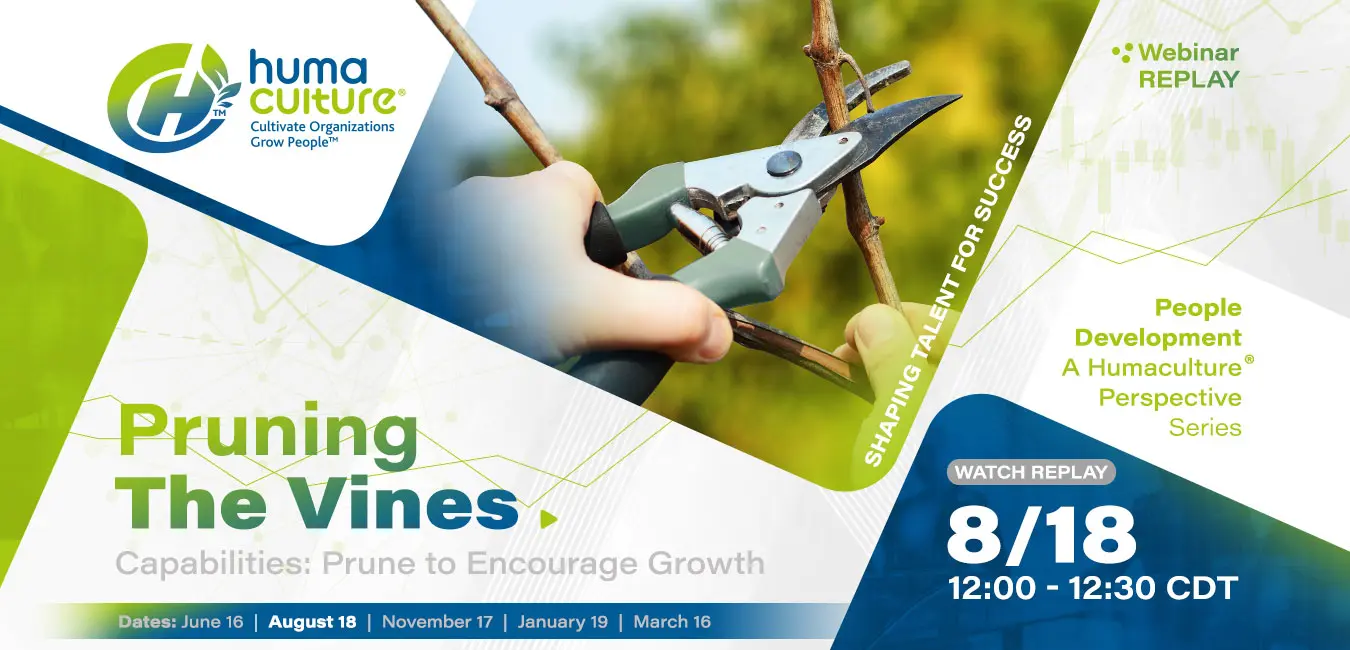
Watch a replay of the second webinar in Humaculture, Inc.’s “People Development: A Humaculture® Perspective Series”, to learn how to shape talent for success by “Pruning the Vines,” using capabilities to prune to encourage growth so employees to fulfill their potential and maximize alignment and productivity.
Steve Cyboran, ASA, MAAA, FCA, CEBS, actuary and strategy consultant
Wes Rogers, Humaculturist® and strategy consultant
Christi Green, RN, MS, PHR, strategy and people consultant
Prune to Encourage Growth Objective
This webinar explores ways organizations can “Prune to Encourage Growth” to shape talent for the future. Capabilities can be used to help organizations select the best plants, determine how best to organize them in the garden, identify strengths and weaknesses, prune away distractions (weak branches) to encourage growth and fruit production.
Key Takeaways
During this session, participants will learn that:
Competencies tend to be just a checklist of skills to manage
People that focus on everything may not be very good at anything
Highly skilled employees may not thrive in management or leadership
Effective people development:
Is rooted in a clear understanding of organizational vision
Assesses skills and needs to support strategic priorities
Explores the employee’s interests, abilities, and desires
Identifies potential for transitions, management, or leadership
Applies principles that work
Available Support
We are available to support you in your strategy, design, compliance, financial, and monitoring needs. Our team includes business and human relations leaders, finance experts, actuaries, clinicians, behavioral health experts, pharmacy experts, and legal resources to guide you through the strategy and compliance process. Please contact us: info@humaculture.com.
Watch
Watch the Shaping Talent for Success: Pruning the Vines – Capabilities: Prune to Encourage Growth Webinar Replay below, or via Rumble or YouTube.
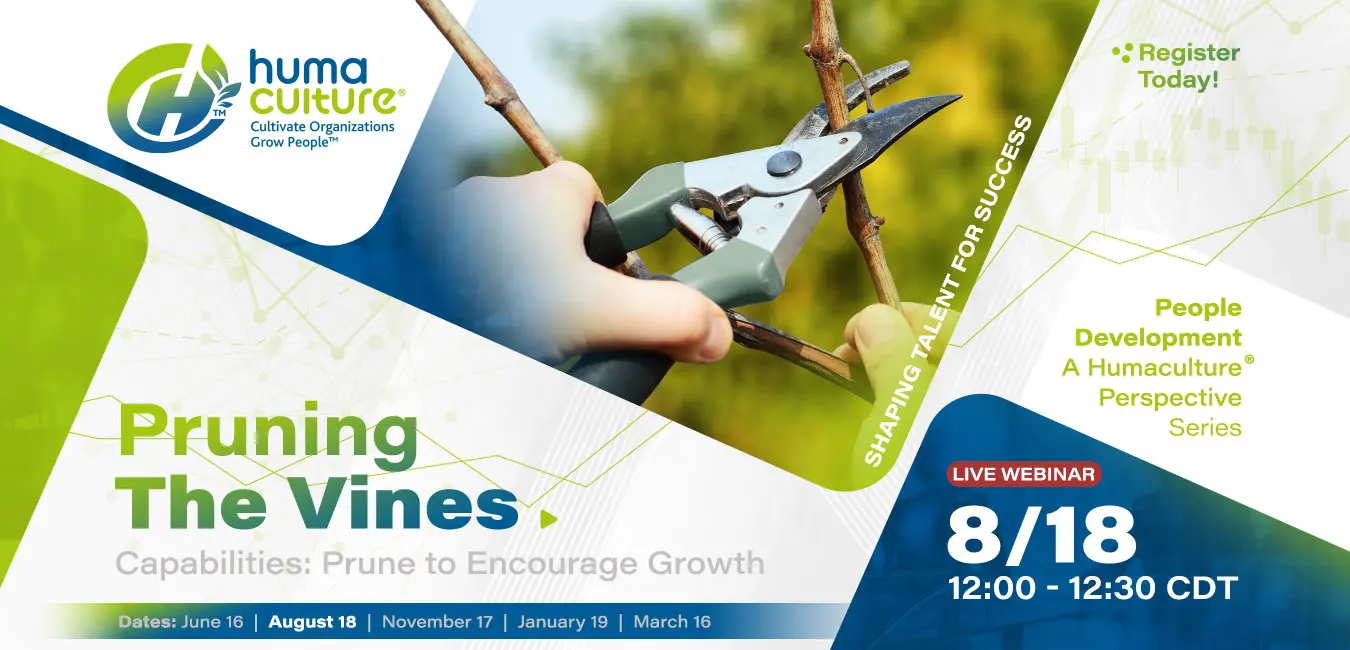
Join us on Thursday, August 18 from 12:00 to 12:30 CDT for the second webinar in Humaculture, Inc.’s “People Development: A Humaculture® Perspective Series”, to learn how to shape talent for success by “Pruning the Vines,” using competencies to encourage growth in employees to fulfill their potential and maximize alignment and productivity.
Steve Cyboran, ASA, MAAA, FCA, CEBS, actuary and strategy consultant
Wes Rogers, Humaculturist® and strategy consultant
Christi Green, RN, MS, PHR, strategy and people consultant
Objective
This webinar explores ways organizations can shape talent for the future. Competencies can be used to help organizations select the best plants, determine how best to organize them in the garden, identify strengths and weaknesses, prune away distractions (weak branches) to encourage growth and fruit production.
Key Takeaways
During this session, participants will learn that:
Competencies are not just a checklist of skills to manage
People that focus on everything may not be very good at anything
Highly skilled employees may not thrive in management or leadership
Effective people development:
Is rooted in a clear understanding of organizational vision
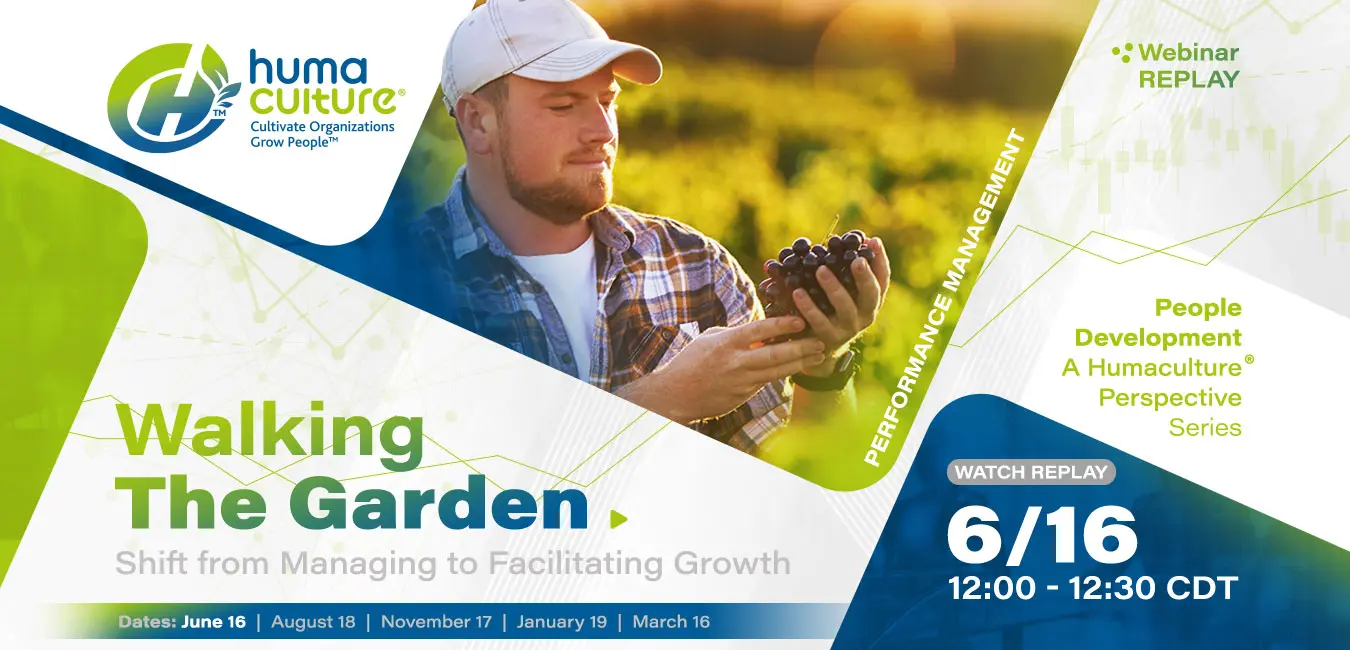
Watch a replay of the first webinar in Humaculture, Inc.’s “People Development: A Humaculture® Perspective Series”, which focuses on how to “Walk the Garden” to build employee relationships, enhance culture, and improve productivity. We discuss transforming your performance management process into one that focuses on facilitating growth and productivity.
Steve Cyboran, ASA, MAAA, FCA, CEBS, actuary and strategy consultant
Wes Rogers, Humaculturist® and strategy consultant
Christi Green, RN, MS, PHR, strategy and people consultant
Objective
This webinar explores ways organizations can shift traditional performance management from the dreaded once-a-year process that is focused on past performance into an on-going discussion. “Walking the Garden” builds strong relationships, keeps people aligned with the culture, helps identify issues early that may inhibit productivity, facilitates growth, prepares your next generation of leaders, and identifies opportunities for transition. This requires proper job design to ensure employees are “planted in fertile soil.”
Key Takeaways
During this session, participants will explore:
The pitfalls of trying to “manage performance”
Why traditional “performance management” is a dreaded process, often detrimental to employee relationships, culture, and productivity
How manager job design and span of control may limit effectiveness
How effective people development will:
Shift from “managing performance” to facilitating growth
Help managers and leaders learn to “walk the garden”
Lead to better alignment between employees’ personal/professional goals and the organization’s strategic priorities
Available Support
We are available to support you in your strategy, design, compliance, financial, and monitoring needs. Our team includes business and human relations leaders, finance experts, actuaries, clinicians, behavioral health experts, pharmacy experts, and legal resources to guide you through the strategy and compliance process. Please contact us: info@humaculture.com.
Watch
Watch the Performance Management: Walking the Garden – Shift from Managing to Facilitating Growth Webinar Replay below, or via Rumble or YouTube.
Join us on Thursday, June 16 from 12:00 to 12:30 CDT for the first webinar in Humaculture, Inc.’s “People Development: A Humaculture® Perspective Series”, to learn how to “Walk the Garden” to build employee relationships, enhance culture, and improve productivity.
Steve Cyboran, ASA, MAAA, FCA, CEBS, actuary and strategy consultant
Wes Rogers, Humaculturist® and strategy consultant
Christi Green, RN, MS, PHR, strategy and people consultant
Objective
This webinar explores ways organizations can shift traditional performance management from the dreaded once-a-year process that is focused on past performance into an on-going discussion. “Walking the Garden” builds strong relationships, keeps people aligned with the culture, helps identify issues early that may inhibit productivity, facilitates growth, prepares your next generation of leaders, and identifies opportunities for transition. This requires proper job design to ensure employees are “planted in fertile soil.”
Key Takeaways
During this session, participants will learn that:
The problems and misnomer of trying to “manage performance”
Why traditional performance management is a dreaded process, often detrimental to employee relationships, culture, and productivity
How manager job design and span of control may limit effective focus
Effective people development will:
Shift from “managing performance” to facilitating growth
Help managers and leaders learn to “walk the garden”
Encourage growth in a specific direction
Lead to better alignment between employees’ personal/professional goals and the organization’s strategic priorities
Please join us on the third Thursday of the month over the next six months for our upcoming People Development series. This series will focus on how to shape talent for success by “pruning the vines” as necessary. We will cover people development from the Humaculture® perspective.
In this webinar series, we explore ways organizations can rethink the traditional performance management and people development processes to make them more meaningful, impactful, and aligned with the organizational vision and strategy – focusing employees and leaders on what is truly important.
Successful horticulturists recognize the overwhelmingly positive impact of pruning. Pruning is the process of removing branches that:
Are not supporting the desired shape of the plant the horticulturist seeks,
Take energy from the plant without maximizing productivity,
Shade or otherwise interfere with the productivity of the other branches.
Effective pruning allows the plant to focus its energies in the most effective and productive areas. People, like plants, often expend energy and time in areas that distract them from achieving their highest and greatest purpose and contributions. In any organization, it is important to help employees remove or overcome the impediments that hold them back, and focus on the areas and interests that will really help them achieve their goals, as well as the strategic priorities of the organization. This series highlights several ways organizations can be innovative and more effective than traditional “performance management.”
To view our prior Strategic Compliance series on the Hidden Opportunities within the CAA and Transparency Rules, click here.
Available Support
We are available to support you in your strategy, design, compliance, financial, and monitoring needs. To that end, our team of consultants, including actuaries, clinicians, behavioral health, pharmacy, and legal resources are available to guide you through the compliance process. Please contact us.
Watch a replay of the fifth webinar in Humaculture, Inc.’s Hidden Opportunities, Strategic Compliance Series, which focuses on how to use fee disclosure to leverage behavioral design, seek strategic advisors, and optimize plan efficiency.
Steve Cyboran, ASA, MAAA, FCA, CEBS, actuary and strategy consultant
Wes Rogers, Humaculturist® and strategy consultant
Jack Towarnicky, LLM, JD, MBA, CEBS, attorney, strategy and compliance consultant
Objective
Beyond basic compliance, this series addresses how to strategically leverage the No Surprises Act and Transparency in Coverage to create a competitive advantage for both the employer and employees. This session focuses on how leveraging Fee Disclosure as a means of “Pest Management” to leverage behavioral design to align interests with your advisors to take a strategic approach and identify conflicts of interest and inferior value in services provided.
Fee Disclosure Key Takeaways
During this session, participants will learn that:
It seems Congress doesn’t believe group health plan fiduciaries are knowledgeable about fees
This may be a first step to shine light on fee reasonableness, conflicts of interest
While the plan fiduciary remains responsible, advisors are put on notice to disclose
Mere compliance ignores the opportunity to cultivate the organizational soil
Leveraging Fee Disclosure as a means of “Pest Management” can:
Identify conflicts of interest and inferior value in services provided
Avoid advisors who haven’t already fully disclosed their compensation
Seek advisors who take a strategic approach, cultivate your organizational soil
Employ behavioral design to align interests
Available Support
We are available to support you in your strategy, design, compliance, financial, and monitoring needs. To that end, our team of consultants, including actuaries, clinicians, behavioral health, pharmacy, and legal resources are available to guide you through the strategy and compliance process. Please contact us: info@humaculture.com.
Watch
Watch the Hidden Opportunities: Pest Management, Minimizing Plan Losses through Fee Disclosure Webinar Replay below, or via Rumble or YouTube.
Join us on Thursday, May 19 from 12:00 to 12:30 CST for the fifth webinar in Humaculture, Inc.’s Hidden Opportunities, Strategic Compliance Series, to learn how to use fee disclosure to leverage behavioral design, seek strategic advisors, and optimize plan efficiency.
Steve Cyboran, ASA, MAAA, FCA, CEBS, actuary and strategy consultant
Wes Rogers, Humaculturist® and strategy consultant
Jack Towarnicky, LLM, JD, MBA, CEBS, attorney, strategy and compliance consultant
Objective
Beyond basic compliance, this series addresses how to strategically leverage the No Surprises Act and Transparency in Coverage to create a competitive advantage for both the employer and employees. In this session we will include a focus on how leveraging Fee Disclosure as a means of “Pest Management” to leverage behavioral design to align interests with your advisors to take a strategic approach and identify conflicts of interest and inferior value in services provided.
Fee Disclosure Key Takeaways
During this session, participants will learn that:
It seems Congress doesn’t believe group health plan fiduciaries are knowledgeable about fees
This may be a first step to shine light on fee reasonableness and conflicts of interest
While the plan fiduciary remains responsible, advisors are put on notice to disclose
Mere compliance ignores the opportunity to cultivate the organizational soil
Leveraging Fee Disclosure as a means of “Pest Management” can:
Identify conflicts of interest and inferior value in services provided
Avoid advisors who haven’t already fully disclosed their compensation
Seek advisors who take a strategic approach, cultivate your organizational soil
Watch a replay of the fourth webinar in Humaculture, Inc.’s Hidden Opportunities, Strategic Compliance Series, which focuses on why mental health issues, costs, and administration continue to increase despite Mental Health Parity efforts and how to effectively respond.
Steve Cyboran, ASA, MAAA, FCA, CEBS, actuary and strategy consultant
Wes Rogers, Humaculturist® and strategy consultant
Jack Towarnicky, LLM, JD, MBA, CEBS, attorney, strategy and compliance consultant
Objective
Beyond basic compliance, this series addresses how to strategically leverage the No Surprises Act and Transparency in Coverage to create a competitive advantage for both the employer and employees. This session focuses on how investing in the organizational soil is “A Lucid Approach” and an example of a strategic action to build organizational resilience and mental fitness by leveraging the purpose, alignment, and health of the organization.
Mental Health Parity Key Takeaways
During this session, participants will learn:
Mental Health Parity in health benefits has not reduced mental health issues
In fact, mental health issues continue to increase despite efforts to equalize benefits
Mere CAA compliance will increase costs and administration
How investing in the soil is “A Lucid Approach” and an example of a strategic action to:
Avoid what can be avoided
Leverage the purpose, alignment, and health of the organization
Build organizational resilience and mental fitness
Communicate all negatives as the result of compliance
Leverage behavioral design to achieve meaningful impact
Available Support
We are available to support you in your strategy, design, compliance, financial, and monitoring needs. To that end, our team of consultants, including actuaries, clinicians, behavioral health, pharmacy, and legal resources are available to guide you through the compliance process. Please contact us: info@humaculture.com.
Watch
Watch the Hidden Opportunities: Preserving the Harvest…Leveraging HSAs Webinar Replay below, or via Rumble or YouTube.
Join us on Thursday, April 21 from 12:00 to 12:30 CST for the fourth webinar in Humaculture, Inc.’s Hidden Opportunities, Strategic Compliance Series, to learn why mental health issues, costs, and administration continue to increase despite Mental Health Parity efforts and how to effectively respond.
Steve Cyboran, ASA, MAAA, FCA, CEBS, actuary and strategy consultant
Wes Rogers, Humaculturist® and strategy consultant
Jack Towarnicky, LLM, JD, MBA, CEBS, attorney, strategy and compliance consultant
Objective
Beyond basic compliance, this series addresses how to strategically leverage the No Surprises Act and Transparency in Coverage to create a competitive advantage for both the employer and employees. In this session we will include a focus on how investing in the organizational soil is “A Lucid Approach” and an example of a strategic action to build organizational resilience and mental fitness by leveraging the purpose, alignment, and health of the organization.
Mental Health Parity Key Takeaways
During this session, participants will learn:
Mental Health Parity in health benefits has not reduced mental health issues
In fact, mental health issues continue to increase despite efforts to equalize benefits
Mere CAA compliance will increase costs and administration
How investing in the soil is “A Lucid Approach” and an example of a strategic action to:
Avoid what can be avoided
Leverage the purpose, alignment, and health of the organization
Build organizational resilience and mental fitness
Communicate all negatives as the result of compliance
Leverage behavioral design to achieve meaningful impact
Watch a replay of the third webinar in Humaculture, Inc.’s Hidden Opportunities, Strategic Compliance Series, which focuses on why the new pharmacy transparency law will not increase transparency; will increase costs, administration, and litigation risk; and how to effectively respond.
Beyond basic compliance, this series addresses how to strategically leverage the No Surprises Act to create a competitive financial advantage for both the plan sponsor and plan participants. This session focuses on leveraging Acquisition Cost Based Pharmacy Pricing as well as Behavioral Design and Messaging as an example of a strategic action organizations can take to optimize this compliance opportunity.
Pharmacy Transparency Key Takeaways
During this session, participants will learn:
Transparency is a misnomer – New rules don’t provide transparency
Pharmacy is likely to continue to be rather “opaque”
The conundrum – mere compliance will likely increase costs, administration, and litigation risk
How to use Acquisition Cost Based Pharmacy Pricing as well as Behavioral Design and Messaging as examples of strategic actions to:
Avoid what can be avoided
Provide true transparency with pharmacy benefits
Empower consumers to make better, more clinically appropriate decisions
Communicate all negatives as the result of compliance
Inform/educate consumers (before they become patients)
Available Support
We are available to support you in your strategy, design, compliance, financial, and monitoring needs. To that end, our team of consultants, including actuaries, clinicians, behavioral health, pharmacy, and legal resources are available to guide you through the compliance process. Please contact us: info@humaculture.com.
Watch
Watch the Hidden Opportunities: Preserving the Harvest…Leveraging HSAs Webinar Replay below, or via Rumble or YouTube.