
Worst to First: How Three NFL Teams Instinctively Strengthened Structures by Applying Humaculture® Topological Model Principles
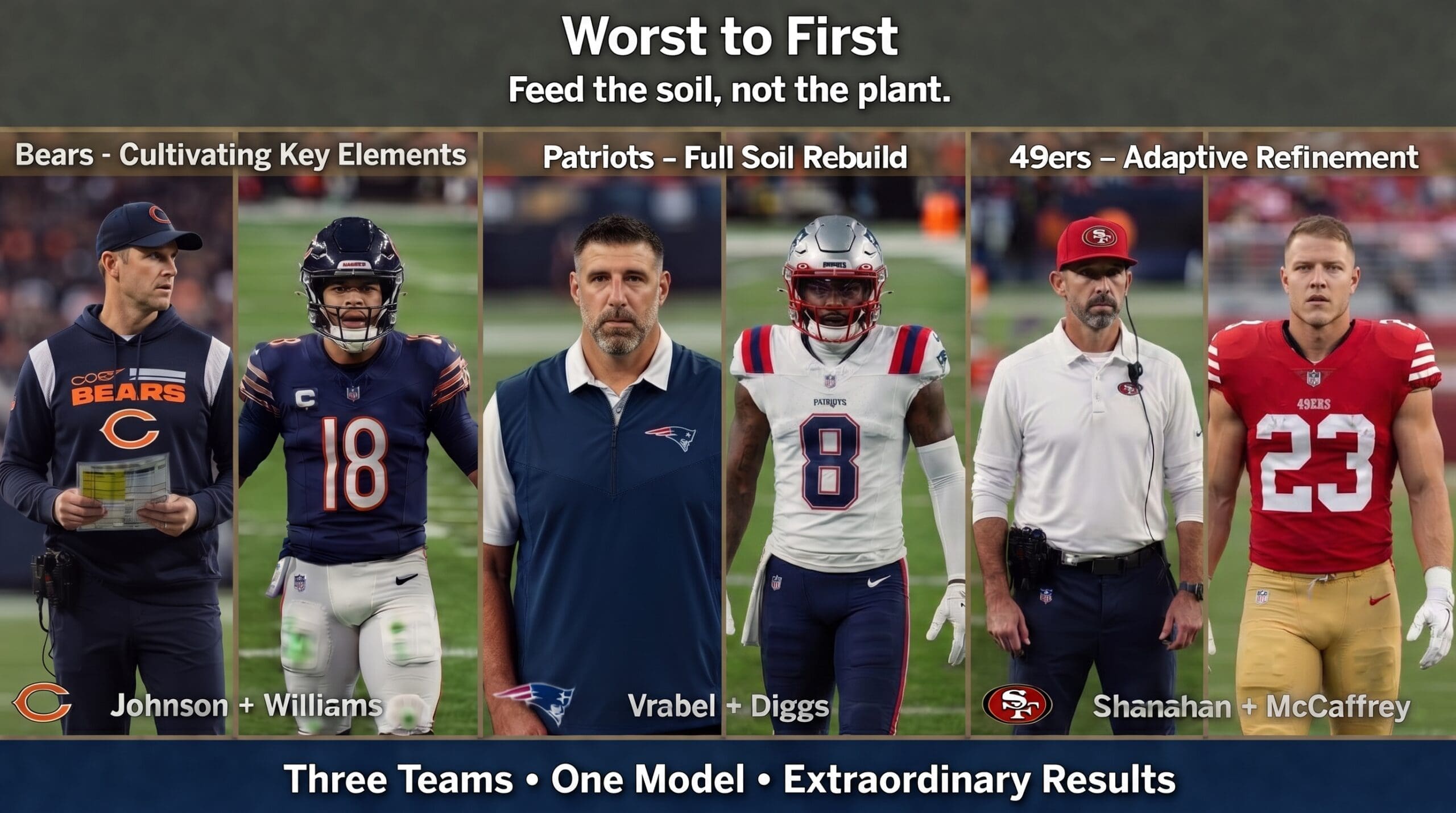
This article is the third in our Team Sports Series, where we explore how elements of the Humaculture® Topological Model are transforming high-performance organizations through unique approaches to cultivation, even when those approaches are applied instinctively rather than through intentional adoption of the full framework. (Read the first two articles in the series: From Underdog to Unbeaten Champions: Indiana Hoosiers and USA Hockey’s Golden Sweep: Lessons in “Feeding the Soil” for Instant Team Cohesion.)
As the 2026 NFL Draft dust settles this week, teams across the league are celebrating their new talent acquisitions. Yet the three 2025 worst-to-first stories featured here offer a deeper lesson: sustainable success doesn’t come from simply adding more “plants.” It comes from cultivating the right “soil” — the Structures and Processes that allow talent to flourish.
Professional sports teams operate in a uniquely demanding ecosystem. Unlike traditional corporations with multi-year planning horizons, they face compressed performance cycles measured in weeks, relentless public and media scrutiny, strict regulatory constraints such as salary caps, and highly fluid talent markets where players move freely through free agency, trades, and contract negotiations. These conditions place extraordinary pressure on the Organization Domain, particularly its Structures (contractual obligations, governance mechanisms, and accountability systems), while amplifying the need for precise alignment across the People Domain and adaptive Performance Nurturing Processes. In this high-stakes environment, even small shifts in how an organization cultivates its “soil” can produce dramatic, visible results.
In the 2025 NFL season, three teams with losing records in 2024, the Chicago Bears (5-12), New England Patriots (4-13), and San Francisco 49ers (6-11), finished among the league’s best. While none of these organizations explicitly used the Humaculture® Topological Model, each coincidentally exemplified powerful applications of its core principles: cultivating unique “soils” (organizational environments) tailored to their specific Domains, Expressions, and Elements. The results were extraordinary.
What these three worst-to-first stories demonstrate is the remarkable potential of the Humaculture® Topological Model as an adaptive framework. When organizations intentionally embrace and fully apply its principles, cultivating unique “soils” tailored to their specific Domains, Expressions, and Elements, extraordinary and sustainable results become not just possible, but predictable.
New England Patriots – Full Soil Rebuild Through Strengthened Structural Commitments
The Patriots’ turnaround began with a clear commitment at the highest level. Owners made significant Structural commitments by entering into contracts that obligated the allocation of Assets (salary cap space, compensation, benefits, and facilities access) to targeted culture-fit veterans who had already thrived in merit-based systems elsewhere. These contractual Structures established formal obligations, accountability mechanisms, and governance rules that aligned People Domain commitments with the organization’s desired culture.
Processes were equally intentional. Head coach Mike Vrabel instituted daily reinforcement practices, including structured team meetings and consistent messaging centered on belief, identity, and the rallying cry “no one gave us a chance… we believed.” These were operationalized through repeatable Cultural Nurturing and Performance Nurturing Processes that built a shared Personal Characteristic of unshakeable confidence and unity across the roster. The result was a complete cultural reset that turned a 4-13 team into a 14-3 division winner.
Player Spotlight: Stefon Diggs
Stefon Diggs arrived from the Texans, where a late-2024 anterior cruciate ligament (ACL) injury combined with scheme and cultural mismatch had limited his production and voice. In New England, the organizational Structures (clear contractual roles, accountability systems, and high-trust governance) combined with aligned Processes and People Domain elements created conditions where Diggs could fully express his strengths. He delivered 85 catches for 1,013 yards and 4 touchdowns while becoming a vocal leader who elevated young quarterback Drake Maye. The difference was not “better soil” in the literal sense — it was a demonstrably different alignment of Structures, Processes, and People that allowed his talent to flourish.
Chicago Bears – Cultivating Key Ecosystem Elements Through Evolved Structures
The Bears focused on building cultivated “soils” from key portions of the ecosystem. They emphasized targeted depth development through refined Structural mechanisms (contractual depth allocation, transparent evaluation systems, and governance frameworks) paired with owner-backed commitment to a new $2+ billion stadium and associated training facilities.
Structures played a central role. Leaders scheduled time for rituals, chants, and mantras to ensure these Processes were not neglected. Explicit norm-setting sessions fostered shared values. The mantra “players make coaches” was operationalized through new power-dynamic Structures that allowed merit to rise naturally.
Processes brought the culture alive daily. Mental-toughness rituals, chemistry-building exercises, and the iconic “Good, better, best” rallying cry became the team’s signature locker room chant after every win, led by head coach Ben Johnson. These operationalized Cultural Nurturing Processes built resilience and high-energy identity.
Player Spotlight: Caleb Williams
As a 2024 rookie, Caleb Williams displayed flashes of brilliance but remained inconsistent in a rigid scheme that did not yet fully nurture his creative decision-making and improvisation. In 2025, the Bears deliberately nurtured that creativity through Skill Development Processes tailored to his strengths, including Run-Pass Option (RPO) concepts, designed rollouts, and simplified reads, and an Environment Domain supported by evolved Structures (clear role definitions, supportive coaching staff, and a scheme that rewarded his natural playmaking ability). The result: 3,942 passing yards, 27 touchdowns, and just 7 interceptions. The “Cardiac Bears” comeback culture emerged as young talent and veterans collaborated at elite levels, a direct outcome of the enriched ecosystem.
San Francisco 49ers – Adaptive Refinement of Structures and Processes
The 49ers executed a dramatic special-teams overhaul. After finishing last in Special Teams Expected Points Added (EPA) in 2024, they waived kicker Jake Moody and signed Eddy Piñeiro. Under coordinator Brant Boyer, the unit surged to second in the NFL in Special Teams EPA in 2025, a 6.5-point swing per game.
This was a clear example of Performance Nurturing Processes refined through Structural mechanisms (personnel decisions and new coordinator governance). They also refined defensive coordination with Robert Saleh’s return, elevating the defense to top-10 rankings. Targeted contractual depth protected star players and maintained roster resilience.
Player Spotlight: Christian McCaffrey
McCaffrey, already a star, benefited enormously from these refined Structures and Processes. Improved special-teams field position gave him more opportunities in favorable situations, better-coordinated defensive schemes created more favorable game scripts that reduced physical wear, and contractual depth that allowed him to stay fresh created conditions for sustained excellence. His production and leadership elevated the entire team, showing how even small, intentional refinements in Structures and Processes can produce outsized results when aligned with the broader organizational “soil.”
The Common Thread: Unique Cultivation Through Strengthened Structures
Each of these three organizations cultivated its “soil” differently by strengthening key Structures in alignment with the Humaculture® Topological Model:
- Patriots: Full rebuild through contractual Structures that obligated Asset allocation to culture-fit veterans, paired with institutionalized Processes that reinforced belief and identity, creating a complete cultural reset from 4-13 to 14-3.
- Bears: Targeted cultivation of key ecosystem elements through evolved Structural mechanisms paired with daily Processes that included mental-toughness rituals, chemistry-building exercises, and the iconic “Good, better, best” rallying cry — all of which unlocked creative talent and long-term stability.
- 49ers: Adaptive refinement of Structural mechanisms (coordination frameworks and contractual depth allocation) and Performance Nurturing Processes (special-teams overhaul and defensive scheme evolution) for maximum efficiency and resilience without a full rebuild.
While these organization didn’t set out to apply the Humaculture® Topological Model, each instinctively aligned key Elements, particularly Structures (including contractual obligations), in ways that produced measurable, sustainable excellence.
What these three worst-to-first stories demonstrate is the power of the Humaculture® Topological Model as an adaptive framework. These are examples of aspects of the model being instinctively employed. What could be accomplished if the Model is embraced and fully applied intentionally?
This article is the third in our Team Sports Series, where we explore how the principles of the Humaculture® Topological Model are transforming organizations into high-performing organizations through unique soil cultivation.
Ready to cultivate your own organization’s “soil”? Whether you lead a football team, Fortune 500 company, or growing startup, the Humaculture® Topological Model scales. Explore the full framework, read the From Underdog to Unbeaten Champions: Indiana Hoosiers or USA Hockey’s Golden Sweep: Lessons in “Feeding the Soil” for Instant Team Cohesion case studies, or connect with our team to begin your turnaround.
Contact:
Steve Cyboran at Steve.Cyboran@Humaculture.com
Wes Rogers at Wes.Rogers@Humaculture.com
Caroline Cyboran at caroline.cyboran@humaculture.com
Website: humaculture.com
LinkedIn: humaculture-inc


